Popular: BusinessWeek | HBR | USNWR | The Economist | Investments | ...
Showing posts with label science. Show all posts

Tuesday, August 26, 2008

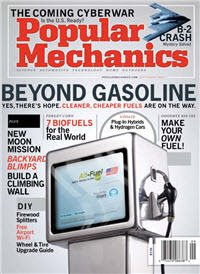
Popular Mechanics, September 2008


Popular Mechanics, September 2008Popular Mechanics, September 2008
English | PDF | 33.4MB

B-2 Crash
How a few drops of water and a confused flight computer brought down a $1.4 billion B-2 bomber.

The Shape of Fuels to Come
With gas prices soaring, next-gen biofuels, electricity and hydrogen have never looked better.

The Coming Digital War
With Pentagon networks under daily attack, PM visits the new Air Force Cyber Command to find out how America fights back.

Shooting the Moon
Later this year, a low-budget kamikaze craft launches to find the key to NASA's lunar plans -- water.

Spin Cycle
Researchers build a spinning, 30-ton metal sphere to measure Earth's magnetic fields.

Portable Printing
Polaroid's inkless PoGo prints photos directly from a mobile phone.

Leading Edge
Mazda's new sedan -- fun and stylish.


[Rapidshare] Download Link
[DepositFiles] Download Link

Click Here to Download...

Monday, August 25, 2008

Science, August 15 2008


Science, August 15 2008Science, August 15 2008
English | PDF | 8.3MB

Cover
A dynamic aurora borealis during a storm over Canada. Energy from the Sun's extended atmosphere is stored at Earth's magnetic field and is released explosively, powering the aurorae. Previously stable aurorae brighten, filament, expand poleward, and cover the sky within 1 to 2 minutes. The energy release starts at an altitude of 130,000 kilometers, at the magnetic equator, near local midnight.

Seasonal-Climate Forecasts Improving Ever So Slowly
Of the dozens of forecasting techniques proffered by government, academic, and private-sector climatologists, all but two are virtually worthless, according to a new study.

Going Deeper into the Grotte Chauvet
Ten years of research have yielded detailed new insights into the stunning images considered the world's oldest cave art. But questions about their age are resurfacing.

Directing a Life in Science
After forgoing theater ambitions, and despite early marriage and motherhood, Olivera Finn has risen through immunology's ranks thanks to her work on cancer vaccines.

Science Scholarships Go Begging
Despite ever-rising college costs, a $4.5 billion federal aid program to lure students into science is vastly undersubscribed.

Climate Change Hot Spots Mapped Across the United States
Taking some of the fuzziness out of climate models is revealing the uneven U.S. impact of future global warming; the most severely affected region may be emerging already.


[FileFactory] Download Link
[DepositFiles] Download Link

Click Here to Download...

Science, August 8 2008


Science, August 8 2008Science, August 8 2008
English | PDF | 10.1MB

Cover
Simulation of a vesicle interacting with a lipid bilayer (lipid head groups in green and blue, tails in cyan; water is not shown). The computation uses a coarse-grained model with over 1 million interaction sites, equivalent to more than 10 million atoms.

Special Section: Challenges in Theoretical Chemistry
Not so long ago, Experiments in the synthetic chemistry lab tended to proceed without detailed calculations and predictions. Today, most organic chemists rely on the results of density functional theory (DFT) calculations to help decide between alternative synthetic routes and to provide guidance on structure assignments. However, such readily solved problems are not where theoretical chemists focus their attention for their own current day-to-day work -- rather, it is on the problems that still defy solution. This special section highlights some areas where theorists feel that progress can be made in the near future on problems that will benefit their experimental colleagues in chemistry and other disciplines.

Deciphering the Genetics of Evolution
Powerful personalities in evolutionary biology have been tussling over how the genome changes to set the stage for evolution.

Industrial-Style Screening Meets Academic Biology
A $100-million-a-year-effort to find chemicals for exploring cellular processes and drug discovery is about to move into production; skeptics say it is struggling to meet its goals.

Can the Vaquita Be Saved?
Scientists are embarking on a last-ditch effort to help the world's most endangered marine mammal avoid the fate of its Chinese cousin, the baiji.


[FileFactory] Download Link
[DepositFiles] Download Link

Click Here to Download...

Science, August 1 2008


Science, August 1 2008Science, August 1 2008
English | PDF | 7MB

Cover
Heavy pollution blankets Tiananmen Square, Beijing, on 27 December 2007. Chinese authorities are taking drastic measures to improve the city's air quality for the Olympics. Bad air is just one of many environmental challenges China is facing.

China's Environmental Challenges

Three Gorges Dam: Into the Unknown
A marvel of engineering, the Three Gorges Dam will start operating at full capacity later this year. Already under way is an epic experiment on how a dam impacts the environment.

Fears Over Western Water Crisis
Dramatic reductions in water flow in the Tarim River, the lifeblood of Xinjiang Province, mean provincial authorities must act fast to conserve water and find alternative water sources.

A Green Fervor Sweeps the Qinghai-Tibetan Plateau
In a controversial venture, officials plan to halt open grazing, eradicate rodents, restore "degraded" grasslands, improve wetlands, and plant many trees and shrubs.

Beijing's Marathon Run to Clean Foul Air Nears Finish Line
Drastic measures have brought down levels of some pollutants; a return to business as usual after the Olympics could be bad for health.


[FileFactory] Download Link
[DepositFiles] Download Link

Click Here to Download...

Science, July 25 2008


Science, July 25 2008Science, July 25 2008
English | PDF | 11.4MB

Cover
Wealthy nations now devote billions of dollars each year to helping low- and middle-income countries confront HIV/AIDS epidemics. Investment in biomedical research has also shot up. What has come of this flood of money? And will there be enough in the future to meet increasing demands?

HIV/AIDS: Follow the Money
Over the past decade, funding for HIV/AIDS research and treatment in low- and middle-income countries has exploded, jumping more than 20-fold to $10 billion last year. The U.S. National Institutes of Health (NIH), the largest funder of basic research, also doubled its budget to nearly $3 billion. How these dollars have been divvied up and what they have accomplished? How countries have dealt with this sudden influx of cash? Who's minding the store and what happens when abuses occur?

From Atop a Mountain, A Deeper Look at the Sun
The world's largest solar telescope could help answer long-standing questions about our nearest star. But with environmental opposition and budgetary challenges, will it get built?

Building a Scientific Legacy on a Controversial Foundation
Most scientists deplore the practice. But the first wave of congressional earmarks for academic research created two centers that have stood the test of time.

Water Everywhere on Early Mars But Only for a Geologic Moment?
Planetary scientists pursuing water and life on Mars must reconcile mounting evidence of a young planet awash in life-sustaining water with a growing realization that the martian surface was likely almost always dry.

Voting: In Your Genes?
At the Behavior Genetics Association meeting, a political scientist presented evidence that DNA has a hand in the intensity of people's partisan political attachments and even in whether they bother to vote.


[FileFactory] Download Link
[DepositFiles] Download Link

Click Here to Download...

Science, July 18 2008


Science, July 18 2008Science, July 18 2008
English | PDF | 6.8MB

Cover
An artist's conception of the antibiotic penicillin and some of the bacteria that have developed resistance to various antibiotics. A special section explores the rise and spread of so-called bad bugs and possible interventions.

Reinventing Rice to Feed the World
With prices of rice and other cereals soaring and granaries emptying, it might take a second green revolution to avert widespread famine.

Simple Sleepers
Classic genetic model organisms -- fruit flies, zebrafish, and roundworms -- are popular newcomers in sleep research laboratories, although debate continues about how much their dozing relates to human slumber.

Acoustics '08 Meeting
- Sound Science Maps Venetian Canals and Peruvian Ruins.
- Ultrasound Uses in Medicine Heat Up.
- Listening to Distant Ice Crack.
- Snapshots from the Meeting.

Ice Scour Disturbance in Antarctic Waters
Icebergs have increasingly scoured the coastlines along the West Antarctic Peninsula as its ice shelves and glaciers have waned, affecting benthic marine communities.

Identification of SLEEPLESS, a Sleep-Promoting Factor
A search for genetic modulators of sleep in Drosophila identified a gene encoding a brain protein that is likely secreted and is required for recovery from sleep deprivation.


[FileFactory] Download Link
[DepositFiles] Download Link

Click Here to Download...

Science, July 4 2008


Science, July 4 2008Science, July 4 2008
English | PDF | 10.3MB

Cover
A mosaic of visible to near-infrared images of the surface of Mercury, obtained by the MESSENGER spacecraft on 14 January 2008. The circular feature in the upper right is the Caloris impact basin, 1500 kilometers in diameter.

Special Section: MESSENGER
Mercury, up-close again.

Preserving Iraq's Battered Heritage
Archaeologists have feared for Iraq's unique archaeological treasures since war began 5 years ago. Now, despite continued unrest, a team returning from southern Iraq bears surprisingly good news.

Epilepsy: When Death Strikes Without Warning
After years of neglect, a devastating effect of epilepsy, sudden death, is drawing new scrutiny.

Competing Teams Plot Two Different Paths to a New Particle Smasher
To make a new collider, physicists in Japan plan to push an existing machine to its limits. Others in Italy hope to cobble one together from old parts and a bright idea.

Self-Sorted, Aligned Nanotube Networks for Thin-Film Transistors
Treating silicon substrates with a silane layer allows them to absorb spin-coated, semiconducting carbon nanotubes, yielding aligned and densely packed nanotube films.


[FileFactory] Download Link
[DepositFiles] Download Link

Click Here to Download...

Scientific American, September 2008


Scientific American, September 2008Scientific American, September 2008
English | PDF | 8.4 MB

Privacy in an Age of Terabytes and Terror
The boundaries are shifting between public interest and "the right to be let alone."

Reflections on Privacy 2.0
Some issues that appear to be questions of privacy turn out to be matters of security or health policy.

Brave New World of Wiretapping
As telephone conversations migrate to the Internet, the government wants to listen in.

Tools of the Spy Trade
Night-vision cameras, biometric sensors and other gadgets already give snoops access to private spaces. Coming soon: palm-size "bug-bots."

How to Keep Secrets Safe
A versatile range of software solutions can protect the privacy of your information and online activities to any desired degree.

The End of Privacy?
Social-networking Web sites may be radically realigning what is considered public and private.


[FileFactory] Download Link
[DepositFiles] Download Link

Click Here to Download...

Friday, August 8, 2008

National Geographic, August 2008


National Geographic, August 2008National Geographic, August 2008
English | PDF | 23.1MB

Ancient Soul of Iran
The glories of Persia inspire the modern nation.

Monkey Paradise
The bush-meat trade stalks an African island ark.

Between Volcanoes
Fire and water collide in Japan's largest national park.

Moscow Never Sleeps
When the sun sets, the Russian capital heats up.

Target Earth
A killer asteroid may be headed our way.


[FileFactory] Download Link
[DepositFiles] Download Link

Click Here to Download...

Sunday, August 3, 2008

Scientific American, August 2008 (科学美国人杂志)


Scientific American, August 2008 (科学美国人杂志)Scientific American, August 2008
科学美国人杂志
English | PDF | 8.6MB

Scientific American is a popular-science magazine, published (first weekly and later monthly) since August 28, 1845, making it the oldest continuously published magazine in the United States. It brings articles about new and innovative research to the amateur and lay audience.

This issue:
China's Children of Smoke

Epidemiologists find molecular clues to air pollution's impact on youngsters. Routine use of screening technologies to measure such biomarkers could, at least theoretically, identify people at risk from specific pollutants.

Facing the Freshwater Crisis
As demand for freshwater soars, global supplies are becoming unpredictable. Existing technologies could avert a water crisis but must be implemented soon.

Why Migraines Strike
Biologists finally are unraveling the medical mysteries of migraine, from aura to pain.


[Rapidshare] Download Link

Click Here to Download...

Friday, August 1, 2008

Science, July 11 2008 《科学》杂志


Science, July 11 2008 《科学》杂志Science, July 11 2008
《科学》杂志 2008年7月11日
English | PDF | 6MB

A science magazine is a periodical publication with news, opinions and reports about science for a non-expert audience. A periodical publication for scientific experts is called a "scientific journal".
Science magazines are read by non-scientists and scientists who want accessible information on fields outside their specialization.
They are an important means of communication between the scientific community and the wider community.


[Ziddu] Download Link

Click Here to Download...

Saturday, July 26, 2008

Nature Magazine, July 24th 2008


Nature Magazine, July 24th 2008Nature Magazine, July 24, 2008
自然杂志2008年7月24日
English | PDF | 24MB

Nature is a weekly international journal publishing the finest peer-reviewed research in all fields of science and technology on the basis of its originality, importance, interdisciplinary interest, timeliness, accessibility, elegance and surprising conclusions. Nature also provides rapid, authoritative, insightful and arresting news and interpretation of topical and coming trends affecting science, scientists and the wider public.


[Rapidshare] Download Link

Click Here to Download...

Friday, July 25, 2008

A Short History of Nearly Everything by Bill Bryson


A Short History of Nearly Everything by Bill Bryson # Author: Bill Bryson
# Hardcover: 560 pages

# Publisher: Broadway; 1 edition (May 6, 2003)

# Language: English

# ISBN-10: 0767908171

# ISBN-13: 978-0767908177

# Format: PDF | 1.1MB


As the title suggests, bestselling author Bryson (In a Sunburned Country) sets out to put his irrepressible stamp on all things under the sun. As he states at the outset, this is a book about life, the universe and everything, from the Big Bang to the ascendancy of Homo sapiens. "This is a book about how it happened," the author writes. "In particular how we went from there being nothing at all to there being something, and then how a little of that something turned into us, and also what happened in between and since." What follows is a brick of a volume summarizing moments both great and curious in the history of science, covering already well-trod territory in the fields of cosmology, astronomy, paleontology, geology, chemistry, physics and so on. Bryson relies on some of the best material in the history of science to have come out in recent years.

This is great for Bryson fans, who can encounter this material in its barest essence with the bonus of having it served up in Bryson's distinctive voice. But readers in the field will already have studied this information more in-depth in the originals and may find themselves questioning the point of a breakneck tour of the sciences that contributes nothing novel. Nevertheless, to read Bryson is to travel with a memoirist gifted with wry observation and keen insight that shed new light on things we mistake for commonplace. To accompany the author as he travels with the likes of Charles Darwin on the Beagle, Albert Einstein or Isaac Newton is a trip worth taking for most readers.


[Ziddu] Download Link

Click Here to Download...

Tuesday, July 22, 2008

Popular Mechanics, August 2008


Popular Mechanics, August 2008 Popular Mechanics, August 2008
English | PDF | 30MB


Popular Mechanics is a service magazine covering a variety of information on home improvement, automotive needs, electronics, computers, telecommunications, outdoors, fitness and science and technology. Each issue contains product evaluations, practical applications, how-to information and news of technological developments.

Popular Mechanics is for people who have a passion to know how things work. It's about how the latest advances in science and technology will impact your home, your car, consumer electronics, computers, even your health. Popular Mechanics - answers for curious minds.

Popular Mechanics is an American magazine devoted to science and technology. It was first published January 11, 1902 by H.H. Windsor, and has been owned since the 1950s by the Hearst Corporation. There is also a Latin American edition that has been published for decades and a newly formed South African version available.

Popular Mechanics features regular sections on automotive, home, outdoors, science, and technology topics. A recurring column is "Jay Leno's Garage" featuring observations by the famed late-night talk show host and vehicle enthusiast.


[Rapidshare] Download Link
[EasyShare] Download Link

Click Here to Download...

Saturday, July 12, 2008

Inventing Temperature: Measurement and Scientific Progress by Hasok Chang


Hasok Chang | Oxford University Press (August 2004) | 304 pages | English | ISBN-10: 0195171276 # ISBN-13: 978-0195171273 | PDF | 1MB

Inventing Temperature: Measurement and Scientific Progress by Hasok ChangWhat is temperature, and how can we measure it correctly? These may seem like simple questions, but the most renowned scientists struggled with them throughout the 18th and 19th centuries. In Inventing Temperature, Chang examines how scientists first created thermometers; how they measured temperature beyond the reach of standard thermometers; and how they managed to assess the reliability and accuracy of these instruments without a circular reliance on the instruments themselves.

In a discussion that brings together the history of science with the philosophy of science, Chang presents the simple eet challenging epistemic and technical questions about these instruments, and the complex web of abstract philosophical issues surrounding them. Chang's book shows that many items of knowledge that we take for granted now are in fact spectacular achievements, obtained only after a great deal of innovative thinking, painstaking experiments, bold conjectures, and controversy. Lurking behind these achievements are some very important philosophical questions about how and when people accept the authority of science.


[Paid4share] Download Link

Click Here to Download...

Friday, July 4, 2008

Science, 27 June 2008


Science 27 June 2008Science, 27 June 2008
《科学》杂志 2008年6月27日
English | PDF | 23MB

Cover
Waiting for a vaccination to curb a meningitis epidemic under way in Koudougou district, Burkina Faso, in March. An affordable new meningitis vaccine in the works promises to prevent, not just control, these frequent epidemics.

An Ill Wind, Bringing Meningitis
Crippling epidemics of meningococcal meningitis sweep across Africa with the onset of the dry season and harsh harmattan winds. An affordable, effective vaccine in the works could change that.

Building the Tree of Life, Genome by Genome
Cheaper sequencing has put many more genes into the hands of researchers trying to sort out the degree of relatedness of a menagerie of organisms. Thanks to one such "phylogenomic" analysis, bird guides may never be the same.

Serotonin Modulates Behavioral Reactions to Unfairness
Individuals with low levels of brain serotonin are less likely to accept an unfair offer of money from other players in a laboratory game.


[Rapidshare] Download Link

Click Here to Download...

Tuesday, July 1, 2008

The Faith of Scientists: In Their Own Words by Nancy K. Frankenberry


Nancy K. Frankenberry | Princeton University Press | 2008-08-28 | ISBN: 0691134871 | 542 pages | PDF | 1.6 MB

The Faith of Scientists is an anthology of writings by twenty-one legendary scientists, from the dawn of the Scientific Revolution to the frontiers of science today, about their faith, their views about God, and the place religion holds--or doesn't--in their lives in light of their commitment to science. This is the first book to bring together so many world-renowned figures of Western science and present them in their own words, offering an intimate window into their private and public reflections on science and faith.

Leading religion scholar Nancy Frankenberry draws from diaries, personal letters, speeches, essays, and interviews, and reveals that the faith of scientists can take many different forms, whether religious or secular, supernatural or naturalistic, conventional or unorthodox. These eloquent writings reflect a spectrum of views from diverse areas of scientific inquiry. Represented here are some of the most influential and colossal personalities in the history of science, from the founders of science such as Galileo, Johannes Kepler, Francis Bacon, Isaac Newton, Charles Darwin, and Albert Einstein, to modern-day scientists like Carl Sagan, Stephen Jay Gould, Jane Goodall, Freeman Dyson, Stephen Hawking, Edward O. Wilson, and Ursula Goodenough. Frankenberry provides a general introduction as well as concise introductions to each chapter that place these writings in context and suggest further reading from the latest scholarship.

As surprising as it is illuminating and inspiring, The Faith of Scientists is indispensable for students, scholars, and anyone seeking to immerse themselves in important questions about God, the universe, and science.


[DepositFiles] Download Link


Click Here to Download...
Thursday, June 26, 2008

100 Greatest Science Discoveries of All Time by Kendall Haven


Kendall Haven “100 Greatest Science Discoveries of All Time"
Libraries Unlimited | 2007-02-28 | ISBN: 1591582652 | 272 pages | PDF | 1.3 MB

Throughout history, science has changed lives and dramatically altered the way in which the universe is perceived. Focusing on the 100 most significant scientific events of all time--from Archimedes' discovery of the two fundamental principles underlying physics and engineering (levers and buoyancy) in 260 B.C.E. to human anatomy, Jupiter's moons, electrons, black holes, the human genome, and more--storyteller Kendall Haven has created a ready reference for those seeking information on science discoveries. Brimming with fascinating and fun facts about 100 scientific breakthroughs, this collection presents the real stories behind the history of science, at the same time offering a panoramic overview of the history of science and an introduction to some of the most important scientists in history. Grades 6 and up.


[DepositFiles] Download Link


Click Here to Download...

Talking Science by Adam Hart-Davis


Adam Hart-Davis | Wiley | 2004-11-05 | ISBN: 0470093021 | 290 pages | PDF | 13.3 MB

Adam Hart Davis has interviewed some of the most influential scientists and thinkers of our time. In this fascinating insight into modern science he presents the stories behind the science, the difficulties behind the discoveries and the future of the findings, as explained by the people themselves.
Adam Hart Davis talks with:-

Jocelyn Bell Burnell (Bath, UK)
Sir Michael Berry (Bristol, UK)
Colleen Cavanaugh (Harvard, US)
Richard Dawkins (Oxford, UK)
Loren Graham (MIT, US)
Richard Gregory (Bristol, UK)
Eric Lander (MIT, US)
Lord May of Oxford (UK)
John Maynard Smith (Sussex, UK)
Rosalind Picard (MIT, US)
Peter Raven (St Louis, US)
Sir Martin Rees (Cambridge, UK)
Eugenie Scott (Oakland, US)
Lewis Wolpert (UCL, UK)

"...a good book for anyone who wants to see how real science is done..." (Focus magazine, No.148, March 2005)

"...As well as being stimulating and awe-inspiring, the transcripts are packed with humour and insight..." (South Coast Magazine, February 2005)

"...this wonderfully accessible book brings to life today's most intriguing scientific discoveries, debates and personalities." (Focus, Number 154, 2005)

"...wonderful resource...in a library with a shelf for scientists as personalities, this volume merits a place." (Journal Of College Science Teaching, June 2006)


[DepositFiles] Download Link

Click Here to Download...

Saturday, June 21, 2008

Science, 20 June 2008


Science, 20 June 2008
《科学》杂志 2008年6月20日
English | PDF | 34MB


A science magazine is a periodical publication with news, opinions and reports about science for a non-expert audience. A periodical publication for scientific experts is called a "scientific journal".
Science magazines are read by non-scientists and scientists who want accessible information on fields outside their specialization.
They are an important means of communication between the scientific community and the wider community.


[Rapidshare] Download Link


Click Here to Download...
Popular: economics | biotech | biography | management | language | technology